All posts by Dr. K Southfield

Multimorbidity With Depression or Anxiety: BMJ Medicine Review

BMJ Medicine has published a systematic review and meta-analysis on primary care and community interventions for people living with multimorbidity involving depression or anxiety. Across 29 randomised controlled trials, the main message is practical but measured: interventions can help, yet most effects are small and some fade with time. Collaborative care stood out as the clearest model with sustained benefit.

Key Takeaway

For patients with long term physical conditions plus depression or anxiety, structured care can improve mental health and quality of life in the short term. The review found the most durable signal for collaborative care, particularly for depression outcomes at 18 to 24 months.

What The Review Found

The BMJ Medicine review included 29 RCTs with 9,487 participants. Studies tested primary care or community based interventions for adults with depression or anxiety and at least one long term physical condition.

The authors grouped interventions into two broad categories:

  • Organisational interventions, including collaborative care, stepped care, and post-discharge interventions.
  • Patient oriented interventions, including exercise, psychotherapy, and psychoeducation.

Organisational interventions produced small improvements in depression symptoms and quality of life by the end of the intervention, but no clear effect on anxiety symptoms. Patient oriented interventions also produced small short term improvements in depression symptoms and quality of life, with weaker long term evidence.

Why Collaborative Care Matters

Collaborative care was the intervention type with the clearest sustained benefit. In subgroup analysis, it continued to show small improvements in depression symptoms at 18 to 24 months. The review also found evidence of benefit from organisational interventions, especially collaborative care, on some physiological outcomes such as HbA1c.

For appraisal and revalidation, this is a useful reminder that multimorbidity with mental health needs is not just a collection of separate problems. The evidence points toward proactive, coordinated, team based care rather than isolated advice or short courses of support.

Questions For Reflection

  • How do we identify patients whose physical health care is being limited by untreated depression or anxiety?
  • Are our reviews structured enough to connect mental health, long term condition monitoring, medication, function, and quality of life?
  • Where could collaborative care principles be applied within existing primary care workflows?
  • How do we avoid assuming that short term improvement means long term benefit?

Bottom Line

This BMJ Medicine review supports the value of integrated care for multimorbidity involving depression or anxiety, while keeping expectations realistic. The gains are generally small, but collaborative care appears to offer the strongest sustained benefit and deserves attention in primary care quality improvement, appraisal, and revalidation discussions.

Source: Primary care and community interventions for multimorbidity involving depression or anxiety: systematic review with meta-analysis, BMJ Medicine. DOI: 10.1136/bmjmed-2025-002400.

Read More

Reducing Low-Value Care in Primary Care: What a BMJ Medicine Review Shows

Low-value care is one of the quiet drains on primary care: it can expose patients to unnecessary treatment, add avoidable workload, and consume resources that could be used for higher-value clinical work. A BMJ Medicine systematic review and meta-analysis brings useful evidence to a practical question for general practice: what actually helps reduce low-value tests and treatments?

The review, titled Effectiveness of different de-implementation strategies in primary care, analysed 140 randomised trials of interventions designed to reduce care that offers little or no benefit to patients. The trials covered common primary care targets including antibiotic prescribing, other drug treatments, imaging, and laboratory testing.

Key takeaway

The clearest signal was not that one simple educational message solves the problem. The review found moderate-certainty evidence that provider education combined with audit and feedback reduced targeted low-value care. Other strategies, including provider education alone, audit and feedback alone, patient education, decision support, and combinations of these approaches, may also reduce low-value care, but the certainty of evidence was generally lower.

In practical terms, this points towards a familiar lesson in quality improvement: changing clinical behaviour usually needs more than information. Clinicians need clear standards, usable data, feedback loops, and support for conversations with patients.

Why low-value care matters in general practice

Low-value care is not just a policy phrase. In day-to-day primary care, it can mean antibiotics for likely viral infections, repeat investigations that do not change management, imaging where harms outweigh benefits, or prescribing patterns that continue because stopping is harder than starting.

For patients, low-value care can create false reassurance, incidental findings, adverse effects, and anxiety. For practices, it can mean extra appointments, follow-up results, prescribing reviews, and administrative work. For the wider NHS, it diverts capacity from care that is more likely to improve outcomes.

What the BMJ Medicine review found

The authors screened more than 13,000 abstracts and included 140 randomised trials. Median follow-up was 287 days. More than half of the trials aimed to reduce antibiotic use, while others focused on drug treatments, imaging, and laboratory testing.

Across the evidence base, de-implementation strategies reduced targeted low-value care by roughly 10-35% in relative terms. Multi-strategy approaches appeared more promising, particularly where patient education was combined with clinician-focused education and feedback. The review also noted that provider education plus audit and feedback had moderate-certainty evidence, making it one of the more defensible choices for service improvement.

What this means for clinicians

For GPs, appraisers, and practice leaders, the review supports a pragmatic approach: choose a specific low-value activity, measure it, give clinicians feedback, and pair that with concise education that explains both the evidence and the intended alternative.

The patient side matters too. Many low-value interventions persist because they are easier to offer than to explain. Patient-facing information, shared decision making, and consistent practice messaging can help reduce the pressure to prescribe, refer, scan, or test when the likely benefit is small.

Questions for appraisal and revalidation

This paper also offers useful material for reflective practice. Clinicians could use it to consider:

  • Which low-value interventions are most common in my clinical setting?
  • Do I have feedback data that shows my own prescribing, testing, or referral patterns?
  • Where could patient information make it easier to avoid unnecessary care?
  • What would be a realistic quality improvement project for my practice or PCN?

Bottom line

The BMJ Medicine review suggests that reducing low-value care in primary care is possible, but it needs structured de-implementation rather than vague encouragement. The strongest practical message is to combine clinician education with audit and feedback, then support patients with clear explanations about why more care is not always better care.

Source: BMJ Medicine: Effectiveness of different de-implementation strategies in primary care. DOI: 10.1136/bmjmed-2025-001343

Read More

Inequalities in HRT Prescribing in UK Primary Care: What a BMJ Medicine Study Means for Menopause Care

A BMJ Medicine cohort study of nearly 2 million women aged 40–60 in UK primary care suggests that hormone replacement therapy (HRT) prescribing varies by ethnicity, deprivation, and region. Published in September 2025 and drawing on a decade of electronic health records from the QResearch database, the study found that only about 19% of women in this age group received two or more HRT prescriptions; and that uptake differed markedly across population groups. The finding matters because it points to a familiar problem in general practice and women’s health: access to menopause care is not always experienced equally. For clinicians, commissioners, and practice teams, this is useful appraisal material. It shifts the conversation away from whether HRT matters and toward a harder question: who is able to access evidence-based menopause care consistently, and who is not?

Key Takeaway

Across a cohort of 1.98 million women, fewer than one in five received sustained HRT prescriptions over a 10-year period. Patterns of prescribing were not evenly distributed: differences linked to ethnicity, deprivation, and geographical region raise concern that menopause care may still be shaped by structural inequality as much as by clinical need; even eight years after NICE menopause guidance was published in 2015.

Why This Matters for UK General Practice

  • Menopause care is now a major primary care workload area, with growing public awareness and patient expectation.
  • Variation in HRT prescribing may reflect barriers in access, consultation quality, continuity, clinician confidence, or service design.
  • If prescribing patterns differ systematically by deprivation or ethnicity, practices may need to look beyond individual consultations and examine population-level equity.

Questions for Reflection

  • Are menopause consultations equally accessible across different patient groups in primary care?
  • Could continuity, appointment access, or local prescribing culture be influencing who receives HRT?
  • What would an equity-focused review of menopause care look like in a GP practice or PCN?

Bottom Line

This BMJ Medicine paper is a reminder that good menopause care is not only about having effective treatments. It is also about making sure access to those treatments is fair, timely, and consistent across the population.

Source: Hirst JA, Mtika WM, Coupland C, Dixon S, Hippisley-Cox J, Hillman S. Inequalities in hormone replacement therapy prescribing in UK primary care: population based cohort study. BMJ Medicine 2025;4:e001349. DOI: 10.1136/bmjmed-2025-001349

Read More

Relational Continuity in England: Why Seeing a Preferred GP Still Matters

A study from BJGP Open suggests that relational continuity in English general practice is stronger for some groups, including older adults with polypharmacy and patients who are more likely to see a preferred GP. That matters because continuity is not just a sentimental ideal. It is closely tied to trust, context, and safer long-term care. In an NHS under pressure, access often dominates the conversation. But this paper is a useful reminder that speed of access and continuity of care are not interchangeable. For many patients, especially those with more complex needs, seeing a familiar clinician may still carry real value.

Key Takeaway

The study suggests that relational continuity in England is unevenly distributed and appears stronger where patients repeatedly see a preferred GP. Older adults with polypharmacy may be more likely to experience that continuity, which raises important questions about who benefits from it and who misses out.

Why This Matters for General Practice

  • Relational continuity can improve clinical context, reduce repetition, and support better shared decision making.
  • Patients with multimorbidity or complex prescribing may particularly benefit from a clinician who knows their history.
  • Current access models can unintentionally erode continuity if practices optimise only for speed or volume.

Questions for Reflection

  • Are current booking systems helping patients see their preferred GP when it matters most?
  • Which patient groups in a practice are most likely to lose continuity under high-demand access models?
  • How should practices balance rapid access with relationship-based care for patients with complex needs?

Bottom Line

This BJGP Open paper is a timely reminder that relational continuity still matters in English general practice. If access reform sidelines continuity, the patients with the greatest need for joined-up care may be the ones who lose most. Source: BJGP Open – view the original article.

Read More

Colchicine: 3,000 Years of Poison, Panacea and Policy Lessons

When Benjamin Franklin asked his contacts in France to send over a mysterious elixir for his gout in the 1760s, he probably did not realise he was ordering a medicine that had already been known, mainly as a poison, for more than a millennium. The concoction, sold as Eau Medicinale by French officer Nicolas Husson, crossed the Atlantic as a fashionable gout cure. What Franklin could not have foreseen is that the same substance would one day appear in the New England Journal of Medicine as a tool for preventing myocardial infarction.

The active ingredient in Husson’s remedy was colchicine, derived from the autumn crocus (Colchicum autumnale). Few medicines in routine UK practice can claim a lineage stretching from ancient Greek botanists to modern cardiology guidelines, but colchicine is one of them.


From ‘One-Day Killer’ to Medical Curiosity

The earliest descriptions of colchicum-like plants sit deep in classical literature. Theophrastus, writing in the 4th century BC, described a deadly plant known as ephemeron, literally “the one-day killer” (Theophrastus, Historia Plantarum). By the 1st century AD, Dioscorides had formalised the name kolchikon after the Black Sea region of Colchis (Dioscorides, De Materia Medica). His warnings were unambiguous: used unwisely, colchicum “kills by choking”.

For more than 1,500 years, Western physicians largely followed this advice. Medieval herbals listed colchicum among plants to be admired but not consumed. Renaissance herbalist John Gerard summed it up neatly when he wrote that its roots were “very hurtfull to the stomacke” (Gerard, Herball, 1597).


The 18th Century Breakthrough: Eau Medicinale

Colchicum’s reputation shifted dramatically in the late 1700s when Nicolas Husson marketed Eau Medicinale as a secret gout remedy. It sold at a premium, 22 shillings per tiny bottle, and was widely imitated but poorly understood. European physicians debated its contents, suggesting everything from digitalis to white hellebore.

In 1814, Londoner John Want solved the mystery. Using a mix of literature review, analysis, and possibly a little espionage, Want identified colchicum as the active ingredient. His findings reshaped gout management across Europe almost immediately.

A plant long classified as a poison had become one of medicine’s most reliable abortive treatments for gout flares.


Why Colchicine Works, and Why It Sometimes Does Not

Colchicine binds to tubulin, preventing microtubule formation. This slows or halts cellular processes that depend on structural scaffolding. For neutrophils, this means impaired migration, reduced endothelial adhesion, and blunted inflammatory signalling. Clinically, this results in anti-inflammatory activity at low doses.

Neutrophils conveniently accumulate colchicine because they express low levels of P-glycoprotein. Other tissues pump it out more effectively, which partly explains why the drug can reduce inflammation without universally causing harm.

However, the mechanism also explains the gastrointestinal side effects familiar to clinicians. Blocking microtubules disrupts cell division in rapidly renewing tissues, particularly the gut and bone marrow. Hence, diarrhoea remains as ancient a side effect as the drug itself.


Modern Evidence: From FMF to MI Prevention

Familial Mediterranean Fever

Colchicine’s modern renaissance began in the 1970s when researchers discovered that daily colchicine prevents the attacks of Familial Mediterranean Fever and reduces the risk of secondary amyloidosis (Ozen et al., N Engl J Med, 2016). This marked the transition of colchicine from simple gout treatment to targeted anti-inflammatory therapy.

Acute Gout

Surprisingly, despite centuries of use, high-quality evidence arrived only recently. The AGREE trial (Terkeltaub et al., Arthritis Rheum, 2010) showed that a low-dose regimen (1.8 mg over one hour) was nearly as effective as traditional high-dose therapy while causing fewer adverse effects. This finding rapidly changed practice worldwide.

Pericarditis

Cardiology then embraced colchicine. The ICAP trial (NEJM, 2013) demonstrated that combining colchicine with standard therapy halved recurrence rates in acute pericarditis. This led to its incorporation into ESC guidelines and rapid uptake across Europe.

Coronary Disease

The LoDoCo2 (NEJM, 2020) and COLCOT (NEJM, 2019) trials further broadened interest. Daily low-dose colchicine (0.5 mg) reduced cardiovascular events, including myocardial infarction and stroke, by roughly 23 to 30 percent. These results positioned colchicine as a serious contender in long-term cardiovascular risk reduction.

A once-feared botanical toxin had become a frontline anti-inflammatory drug across multiple specialties.


Regulatory Plot Twist: When Safety Creates a Monopoly

For decades, colchicine in the United States existed in a regulatory grey zone. It was widely manufactured, rarely questioned, and astonishingly cheap.

The FDA’s 2006 Unapproved Drugs Initiative changed that. The programme encouraged companies to fund modern studies in exchange for temporary market exclusivity. URL Pharma undertook the necessary research, including pharmacokinetic studies and the AGREE trial, and gained approval for Colcrys in 2009.

Once approved, the FDA ordered all other unapproved colchicine products off the market. Overnight, a ten-cent pill became a five-dollar pill.

The backlash was swift. US senators accused URL Pharma of exploiting regulation to create a monopoly. Analysts estimated that if all gout patients required daily colchicine at the new price, annual costs could exceed 11 billion dollars.

Generics eventually returned after exclusivity expired, but prices have never returned to the pre-2009 level. The episode became a case study in how well-intended policy can distort markets.

In 2020, partly because of such cases, the programme was formally discontinued.


The Road Ahead

Colchicine’s journey mirrors the evolution of medicine itself. It has travelled from ancient herbal lore to modern pharmacology, from empirical remedies to targeted anti-inflammatory therapy. Its expanding role in cardiovascular medicine continues to attract attention, and further repurposing trials are underway.

Yet the Colcrys episode remains a lasting reminder that the scientific merit of a drug can be overshadowed by regulatory and economic forces. Poorly designed incentives can restrict patient access to medicines that humanity has relied on for centuries.

For UK doctors, colchicine’s story is more than an interesting historical footnote. It is a window into how policy, economics, and pharmacology intersect, and how even the most familiar medicines can have dramatic backstories.


Selected References

  • Theophrastus. Historia Plantarum, 4th century BC

  • Dioscorides. De Materia Medica, 1st century AD

  • Gerard J. The Herball, 1597

  • Terkeltaub R et al. AGREE Trial. Arthritis Rheum. 2010

  • Ozen S et al. FMF Review. N Engl J Med. 2016

  • Imazio M et al. ICAP Trial. N Engl J Med. 2013

  • Nidorf SM et al. LoDoCo2 Trial. N Engl J Med. 2020

  • Tardif J et al. COLCOT Trial. N Engl J Med. 2019

  • FDA Unapproved Drugs Initiative, US HHS, 2006 to 2020
Read More

Recurrent UTIs : a non antibiotic path

Breaking the Cycle of Recurrent UTIs: An Innovative Non-Antibiotic Approach

Recurrent urinary tract infections (rUTIs) are among the most common and frustrating clinical conditions faced by healthcare professionals. Not only do they impair patients’ quality of life, but they also significantly contribute to antibiotic resistance—a growing global health crisis. A recent groundbreaking study published in Probiotics and Antimicrobial Proteins offers promising evidence that a carefully designed non-antibiotic “bundle” treatment can effectively manage rUTIs, drastically reducing antibiotic use while improving patient outcomes.

Tackling the rUTI Challenge

Women suffering from rUTIs often find themselves in a relentless cycle of infections, symptoms, and antibiotics. The overuse of antibiotics is especially concerning due to the rising prevalence of multidrug-resistant organisms. Recognizing this, researchers from the ASFO Santa Maria degli Angeli Hospital in Pordenone, Italy, investigated a multimodal non-antibiotic strategy, targeting both infection prevention and overall patient wellness.

The Non-Antibiotic Bundle: A Holistic Intervention

The study enrolled 47 women experiencing recurrent UTIs, testing a comprehensive six-month intervention that combined:

  • Behavioral Changes: Enhanced hydration (minimum 2 liters daily), improved bowel management, and optimized intimate hygiene practices.
  • Phytotherapy: Regular consumption of cranberry extract and D-mannose, both known to inhibit bacterial adhesion to urothelial surfaces.
  • Probiotics: A combination of oral and vaginal probiotics containing strains such as Lactobacillus, Bifidobacterium, and Saccharomyces boulardii, aimed at restoring healthy vaginal and intestinal microbiota.

Remarkable Results: Reduced Antibiotic Use and Improved Quality of Life

After six months, the results were impressive:

  • 76% reduction in urinary tract infections compared to the previous six months.
  • Over 90% decrease in antibiotic exposure, significantly minimizing the risk of antimicrobial resistance.
  • Significant improvement in chronic symptoms like abdominal discomfort, urinary urgency, and suprapubic pain.
  • Enhanced quality of life reported by over 80% of participants.

Clinical Implications: A Paradigm Shift in UTI Management

The findings suggest that a holistic, multimodal strategy can profoundly change the standard approach to managing rUTIs. By focusing on patient education, lifestyle adjustments, and microbiota health rather than solely relying on antibiotics, clinicians have a powerful new tool to combat recurrent infections.

Moving Forward

Although this initial study had a modest sample size, the outcomes strongly support further large-scale trials. By reducing antibiotic dependence, healthcare providers can not only manage rUTIs more effectively but also contribute to global antibiotic stewardship efforts.

This study represents an important step toward a future where non-antibiotic solutions play a central role in infectious disease management. It’s time to shift our clinical focus towards strategies that not only address symptoms but also promote long-term health and resilience against infections.

Reference:
Venturini, S., Reffo, I., Avolio, M. et al. (2024). The Management of Recurrent Urinary Tract Infection: Non-Antibiotic Bundle Treatment. Probiotics & Antimicro. Prot., 16, 1857–1865. https://doi.org/10.1007/s12602-023-10141-y

Read More

Anastrozole and Breast Cancer Prevention

Anastrozole’s repurposing as a preventive treatment marks a significant advancement in breast cancer care. This post examines Anastrozole’s action, effectiveness, side effects, dosage, UK cost, and eligibility criteria.

Mechanism of Action Anastrozole is an aromatase inhibitor. It works by blocking aromatase, reducing estrogen production. Since some breast cancers are estrogen-dependent, lowering estrogen levels can prevent these cancer cells from growing.

Efficacy Research shows that Anastrozole cuts the risk of developing breast cancer by 50% in high-risk postmenopausal women when taken daily for five years. This significant reduction underscores its role as a primary preventive measure.

Side Effects Side effects are a consideration with Anastrozole use. While it can cause symptoms like joint pain and hot flushes, these are typically manageable. The potential benefit of reducing breast cancer risk is a compelling reason for its use despite these side effects.

Dosage The recommended dose of Anastrozole for breast cancer prevention is one 1 mg tablet daily. It can be taken with or without food, offering flexibility for incorporation into daily life.

Cost in the UK The cost is low due to its off-patent status. A five-year course is about £78, a small price for the potential health benefits and the cost savings to the healthcare system by preventing cancer.

Eligibility The treatment is aimed at postmenopausal women who are at a moderate to high risk of breast cancer, which includes those with a family history of the disease. The goal is to offer protection to those most likely to benefit from the drug.

Conclusion Anastrozole offers a cost-effective, preventive option for breast cancer in a targeted group of women. Its introduction is a proactive step in cancer prevention, promising to reduce the incidence and the associated healthcare costs.

References

  • Data on Anastrozole’s efficacy and cost-effectiveness are available from NHS England and Cancer Research UK.
  • Information on dosage and side effects can be found in medical guidelines provided by the National Institute for Health and Care Excellence (NICE).

Read More

QOF 2023/24 and New Cholesterol Indicators

Cholesterol constitutes a component within the clinical domains section of the Quality and Outcomes Framework (QOF).

There exist two QOF indicators concerning Cholesterol:

  1. CHOL001 – This indicator encompasses patients listed in the QOF registers for Coronary Heart Disease (CHD), Peripheral Arterial Disease (PAD), Stroke/Transient Ischemic Attack (TIA), or Chronic Kidney Disease (CKD). It pertains to individuals who, during the last six months of the fiscal year, receive a prescription for a statin. Alternatively, if a statin is declined or deemed clinically unsuitable, another form of lipid-lowering therapy is prescribed. Patients aged 17 years or older, who are on any of these registers and concurrently diagnosed with diabetes, are excluded from this particular indicator.Personalized care adjustments (PCA) come into effect when patients meet certain criteria and have been properly coded with any of the following situations:
    • The patient possesses a palliative care code on their medical record dated on or after April 1, 2008.
    • They decline or are clinically unsuitable for both statin treatment and all available alternative lipid-lowering therapies within the current fiscal year.
    • The patient’s medical record indicates they are on the maximum tolerated cholesterol-lowering treatment within this fiscal year.
    • The patient’s medical record indicates an adverse reaction to lipid-lowering therapy or a code indicating that lipid-lowering therapy is not indicated, contraindicated, or declined within this fiscal year.
    • Patients newly registered at the medical practice within the final three months of the fiscal year.
  2. CHOL002 – This indicator encompasses patients listed in the QOF registers for Coronary Heart Disease (CHD), Peripheral Arterial Disease (PAD), or Stroke/Transient Ischemic Attack (TIA). It applies to patients who have a recorded value of non-HDL cholesterol lower than 2.5 mmol/L within this fiscal year. Alternatively, if non-HDL cholesterol is not recorded, the indicator applies to patients with a recorded value of LDL cholesterol lower than 1.8 mmol/L within this fiscal year.Personalised Care Adjustments applies in situations where the patient either declines a cholesterol blood test within this fiscal year or has registered within the last nine months of the fiscal year.Personalised Care Adjustments refers to specific circumstances or criteria under which adjustments or exceptions are made to the requirements or conditions of the QOF indicators related to cholesterol management. These personalized care adjustments take into consideration various factors that might impact a patient’s eligibility or treatment plan, allowing for a more tailored approach to their care. The purpose of PCA is to ensure that patients’ individual needs and situations are considered when assessing their compliance with the QOF indicators and when determining the appropriate treatment or interventions for them.

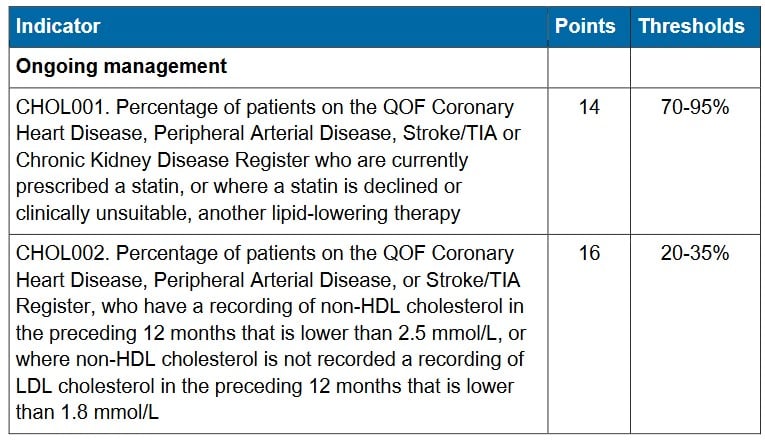
CHOL001 – This indicator assesses the percentage of patients registered in the QOF for conditions like Coronary Heart Disease (CHD), Peripheral Arterial Disease (PAD), Stroke/Transient Ischemic Attack (TIA), or Chronic Kidney Disease (CKD) who are currently prescribed a statin. In cases where a statin is declined or not clinically suitable, another lipid-lowering therapy is considered. The achievement of this indicator carries a total of 14 points, with the requirement that 95% of patients on the CHD, PAD, stroke, and CKD registers receive statin treatment. This indicator amalgamates what used to be separate assessments within each of these domains into one comprehensive measure.

However, patients aged 17 and above with diabetes have a distinct indicator for statin prescription and are excluded from this new combined indicator, even if they have concurrent CHD, PAD, or stroke conditions.

Exceptions to this indicator include patients on the palliative care register. Given the substantial overlap between cardiovascular disease and diabetes, the number of excluded patients might be considerable.

Personalised care adjustments (PCA) may apply to patients who have declined a statin treatment. Regarding adverse reactions, the majority of patients will be prescribed a statin. Additionally, patients receiving bempedoic acid, ezetimibe, icosapent ethyl, inclisiran, or a PCSK9 inhibitor will be included in the indicator only if they have a documented adverse reaction to a statin. Notably, recording an adverse reaction or allergy to a statin will not exempt a patient from the indicator. Exceptions may also be granted if patients have codes indicating informed dissent or an adverse reaction to lipid-lowering therapy in general.

The standard prescription timelines apply, necessitating issuance in the latter half of the QOF year. Prescriptions spanning six months or more may not be captured by this indicator.

While patients with cardiovascular disease typically receive statin prescriptions, the number of chronic kidney disease patients prescribed statins might be lower. It could be advantageous to focus efforts on this subgroup at the beginning of the year.

For patients intolerant to statins, there is now greater emphasis on alternative medications. Patients who were previously exception reported might benefit from assessing the suitability of alternative cholesterol-lowering medications.

CHOL002 – This indicator gauges the percentage of patients registered in the QOF for conditions like Coronary Heart Disease (CHD), Peripheral Arterial Disease (PAD), or Stroke/Transient Ischemic Attack (TIA) who have a recorded non-HDL cholesterol level below 2.5 mmol/L within the preceding 12 months. Alternatively, if non-HDL cholesterol is not recorded, the indicator applies to patients with a recorded LDL cholesterol level below 1.8 mmol/L within the same timeframe.

There are distinct differences in this indicator. First, it excludes patients with chronic kidney disease. Second, it includes patients with diabetes or on the palliative care register, provided they are also on the CHD, PAD, or stroke registers. Consequently, the patient population assessed by this indicator significantly differs from CHOL001.

Presently, there are limited exception reports available for this indicator. Patients are excepted only if they decline a cholesterol test or register with the practice after July in the QOF year, with a specific code indicating a declined test triggering this exception.

As of the current business rules for the 2023/2024 period, there are no exception reports for treatment allergies, informed dissent, or being on the maximum tolerated treatment dose.

The indicator’s criteria remain consistent, with non-HDL cholesterol being required to be below 2.5 mmol/L. If non-HDL data isn’t available, LDL cholesterol should be less than 1.8 mmol/L. Non-HDL takes precedence over LDL measurements, even if subsequent LDL data is available. This prioritization is particularly significant in cases of changes in local lab reporting or patient movement between practices.

This indicator carries a total of 16 points, with low thresholds for achievement, starting at 20% and reaching the full 16 points for 35% attainment.

Given that this indicator uses codes not previously featured in the QOF, it’s crucial to ensure their recognition. These codes can be derived from lab tests, point-of-care patient tests, or transcribed from hospital letters. Maintaining up-to-date templates for manual entry is essential.

Identifying patients with elevated values, adjusting medication, and retesting demands time. Initiating this process early on enhances the likelihood of achieving high scores in this indicator. The cholesterol indicators together offer a total of 30 points.


Read More

Short bouts of vigorous activity can reap huge benefits

A substantial cohort study suggests that for adults who cannot or do not prefer regular exercise, engaging in short bursts of vigorous activity, as simple as climbing a flight of stairs, may still significantly reduce their risk of cancer. The study, led by Dr. Emmanuel Stamatakis and his team from the University of Sydney in Australia, found that even as little as 1 minute of vigorous intermittent lifestyle physical activity (VILPA) per day, totaling 4.5 minutes weekly, was associated with a 20% decrease in the overall risk of cancer.

The researchers also observed a 31% reduction in the risk of physical activity-related cancer, which includes cancer types known to be possibly linked to low levels of physical activity. These findings were published in JAMA Oncology.

The potential impact of VILPA on cancer prevention is promising, particularly for individuals who cannot or lack motivation to exercise during leisure time. The study’s authors advocate for further exploration through long-term trials with cancer-related biomarkers and well-designed cohort studies using wearable devices to better understand VILPA’s potential as a cancer prevention intervention for non-exercisers and those who find traditional exercise unappealing.

Interestingly, the researchers found that even a “minimal dose” of VILPA, equivalent to 3.4 minutes of vigorous activity per day, was associated with a 17% reduced risk of total cancer incidence. Likewise, 3.7 minutes of daily vigorous activity was linked to a 28% decreased risk of physical activity-related cancer incidence.

An editorial accompanying the study emphasizes that physical activity can have additional benefits, such as improving physical fitness, muscle strength, fatigue related to cancer, and overall quality of life for cancer survivors. However, more research is needed to determine if the results can be applied to cancer patients specifically.

The study involved 22,398 adults from the U.K. Biobank accelerometry subsample, with participants who reported no leisure time exercise and engaged in one or fewer recreational walks per week. Vigorous intermittent lifestyle physical activity was defined as short bursts of intense physical activity, like fast walking or stair climbing, and was measured using wearable trackers, such as wrist-worn accelerometers.

The participants were followed for an average of 6.7 years, during which 2,356 new cancer events were reported, including 1,084 cases related to physical activity. The analyses were adjusted for various factors such as age, sex, body mass index, education level, smoking status, alcohol consumption, sleep duration, fruit and vegetable consumption, medications, parental cancer history, cardiovascular disease, daily durations of light- and moderate-intensity physical activity, and daily duration of longer vigorous exercise bouts.

The study highlights the importance of incorporating even sporadic episodes of brief, vigorous physical activity into daily life as it positively impacts health and helps reduce the risk of disease. Ultimately, any form of physical activity is beneficial, and the key is to establish exercise as a regular habit for overall well-being.


Primary Source

JAMA Oncology

Source Reference: Stamatakis E, et al “Vigorous intermittent lifestyle physical activity and cancer incidence among nonexercising adults” JAMA Oncol 2023; DOI: 10.1001/jamaoncol.2023.1830.

Secondary Source

JAMA Oncology

Source Reference: Wengström Y, et al “Short bouts of physical activity — good for health?” JAMA Oncol 2023; DOI: 10.1001/jamaoncol.2023.1810.

Read More

Anakinra, the elixir of youth?

Revitalizing Aging Blood System with Anti-Inflammatory Drug

A recent study published in Nature Cell Biology has found that an anti-inflammatory drug used for rheumatoid arthritis may be able to reverse some of the effects of aging on the blood system in mice. The drug, called anakinra, has been shown to have rejuvenating effects on the body’s blood cell-producing stem cells, which can become affected by age and lead to decreased production of red and white blood cells, impaired DNA protection, and increased risk of blood cancers.

Investigating the Hematopoietic Stem Cell Niche

Lead author Carl Mitchell and senior author Dr. Emmanuelle Passegué, Director of the Columbia Stem Cell Initiative, investigated the environment, or niche, that blood stem cells are found in, instead of the cells themselves. They discovered evidence of inflammation and deterioration in the aging hematopoietic stem cell niche that could be responsible for their loss of function. Blocking the action of the inflammatory signal interleukin-1 beta (IL-1B) with the drug anakinra returned the blood stem cells to a much healthier state.

Looking to Translate Results to Humans

The research team now aims to find out if the same process could work in human clinical trials. They also want to understand if improving the health of the stem cell niche earlier in life, such as in middle age, could have even more rejuvenating effects. “Only by having a deep molecular understanding will it be possible to identify approaches that can truly delay aging,” says Passegué.

Promising Results for Healthier Blood Production

The results of the study indicate that strategies aimed at maintaining a healthier blood production system in the elderly hold promise. “These results indicate that such strategies hold promise for maintaining healthier blood production in the elderly,” says Mitchell. By rejuvenating the body’s blood cell-producing stem cells, the drug anakinra may offer a new way to extend healthspan and potentially lifespan in older adults.

Reference: Mitchell CA, Verovskaya EV, Calero-Nieto FJ, et al. Stromal niche inflammation mediated by IL-1 signalling is a targetable driver of haematopoietic ageing. Nat Cell Biol. 2023;25(1):30-41.
https://www.nature.com/articles/s41556-022-01053-0.epdf

Read More